A reliable network is no longer a luxury for small and medium-sized businesses in Kenya. Whether you run a retail shop, accounting firm, school, clinic, warehouse, hotel, or growing office, your business depends on connectivity every day.
Cloud applications, M-Pesa and payment systems, CCTV cameras, printers, VoIP phones, shared files, point-of-sale systems, and internet access all depend on one thing: a stable network.
Unfortunately, many SMEs only think about their network when it stops working.
The good news is that you don't need an expensive enterprise setup to build a reliable business network. With the right equipment, you can create a network that is secure, scalable, and ready for growth.
Here are the five essential networking devices every SME in Kenya should consider.
1. Business-Grade Router
The router is the gateway between your business network and the internet.
Many small businesses simply use the router supplied by their ISP. While this may work for a very small office, ISP routers often become limiting as the business grows.
A proper business router gives you greater control over your network, including user management, security, bandwidth management, VPNs, multiple internet connections, and network segmentation.
For a Kenyan SME, this becomes particularly important when you have multiple services competing for the same internet connection.
For example, your staff may be browsing the internet while customers are using Wi-Fi, CCTV cameras are communicating with a server, and your POS system is processing transactions.
A good router helps keep these services organized and reliable.
Look for:
- Dual-WAN or multi-WAN support
- Firewall functionality
- VPN support
- VLAN support
- Bandwidth management
- Guest network support
- Good monitoring and logging
For businesses that cannot afford significant downtime, dual internet connections can also provide redundancy. Your primary connection could be fibre while a second connection provides backup.
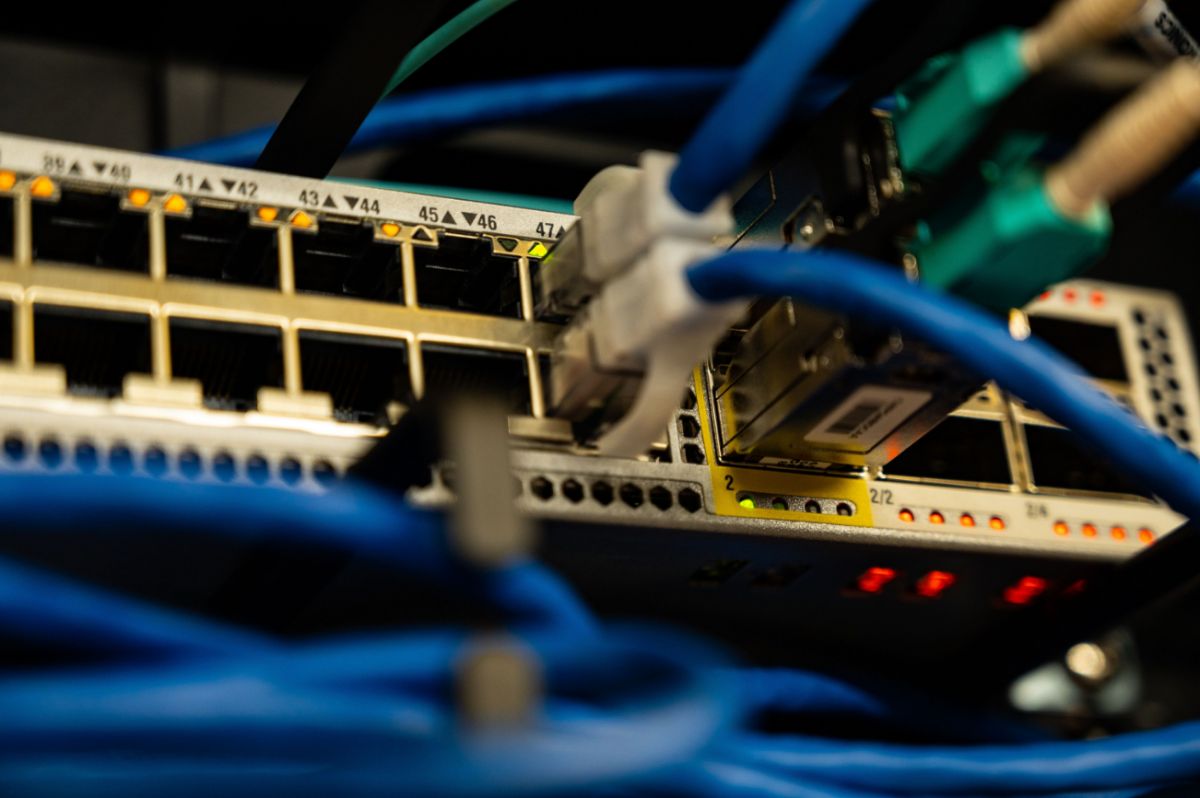
2. Managed Network Switch
Once you have more than a few devices, connecting everything directly to the router quickly becomes impractical.
This is where a network switch comes in.
A switch allows you to connect computers, printers, servers, access points, CCTV cameras, POS systems, VoIP phones, and other network devices.
For an SME, I recommend considering a managed switch rather than an unmanaged switch if you expect the business to grow.
A managed switch gives you much greater control over your network.
For example, you can create separate networks for:
- Staff computers
- CCTV cameras
- Guest Wi-Fi
- POS systems
- Servers
- Management devices
This is known as network segmentation using VLANs.
It means that your guest Wi-Fi doesn't have to sit on the same network as your accounting system or CCTV cameras.
If your business has CCTV, consider PoE (Power over Ethernet) switches. PoE allows compatible devices such as IP cameras and wireless access points to receive both network connectivity and power through the same Ethernet cable.
That can make installation much cleaner.
3. Business Wi-Fi Access Points
Wi-Fi is often one of the most frustrating parts of an SME network.
You may have experienced this
"The internet is working, but the Wi-Fi is slow."
The problem isn't always the internet connection.
Your access point may be overloaded, poorly positioned, experiencing interference, or simply not designed for the number of users connected to it.
Instead of relying on a single consumer Wi-Fi router to cover an entire office, consider installing dedicated business access points.
Multiple access points can provide better coverage throughout your premises while allowing users to move around without constantly reconnecting.
For businesses with larger offices, warehouses, hotels, schools, or multiple floors, a centrally managed Wi-Fi system can make administration much easier.
Look for:
- Wi-Fi 6 or newer
- Central management
- Multiple SSIDs
- VLAN support
- Guest networks
- Roaming support
- PoE capability
Don't forget that access point placement matters. Installing a powerful access point in the wrong location will not necessarily give you good coverage.
4. Network Firewall
A firewall is your business's first line of defence against many network-based threats.
While some routers include firewall functionality, growing businesses may benefit from a dedicated security appliance.
A firewall can help control what enters and leaves your network while providing features such as VPN access, web filtering, intrusion prevention, traffic monitoring, and application control.
This is especially important as more businesses move their operations online.
Your network may contain sensitive information such as:
- Customer information
- Financial records
- Employee data
- Business documents
- Passwords
- POS systems
- Servers
- CCTV systems
A firewall helps you control access to these resources.
For example, your CCTV cameras should not necessarily have unrestricted access to your accounting server. Similarly, visitors using your guest Wi-Fi should not be able to access company computers.
Security should be designed into the network from the beginning rather than added after an incident.
5. Network Rack, Patch Panel & UPS
This is the equipment that businesses often overlook.
You can have excellent routers, switches and access points, but if everything is sitting on a desk surrounded by tangled cables and connected directly to unreliable power, you still have a fragile network.
A proper network installation should include a suitable network rack, patch panel, cable management and UPS.
The rack keeps networking equipment organized and protected.
A patch panel makes structured cabling easier to manage and troubleshoot.
A UPS provides temporary backup power and protects equipment from some power-related problems.
This is particularly useful in environments where power interruptions can occur.
For critical equipment, you may want your network infrastructure to remain operational long enough for a generator, inverter, or alternative power source to take over.
A clean network is also an easier network to troubleshoot.
When something fails at 10 PM, you don't want to spend an hour trying to identify which cable goes where.
A Simple SME Network
A typical growing Kenyan SME might eventually have a network that looks something like this:
Internet Connection
↓
Business Router / Firewall
↓
Managed PoE Switch
↓
├── Computers
├── Printers
├── CCTV Cameras
├── Wi-Fi Access Points
├── POS Systems
├── Servers/NAS
└── VoIP Phones
The network can then be divided into separate VLANs so that different types of devices don't automatically have access to everything else.
This provides a much better foundation for growth.
Don't Buy Networking Equipment Based Only on Price
One of the biggest mistakes SMEs make is choosing networking equipment purely because it is cheap.
A KSh 3,000 router may appear attractive compared to a KSh 15,000 or KSh 30,000 business-grade device.
But the real cost comes when your business starts experiencing:
- Frequent disconnections
- Slow Wi-Fi
- Network congestion
- Security problems
- Difficult troubleshooting
- Limited scalability
- Expensive downtime
The cheapest equipment isn't necessarily the cheapest solution.
Instead, think about total cost of ownership.
A reliable network that serves your business for several years can be considerably cheaper than repeatedly replacing inadequate equipment.
What Should a Small Kenyan Business Buy?
You don't necessarily need all five categories on day one.
A small office with 5–10 employees might start with:
1. Business router/firewall
2. 8–16 port managed switch
3. One or two Wi-Fi access points
4. Small network rack
5. UPS
As the business grows, you can add additional switches, access points, CCTV, servers, backup internet connections and other infrastructure.
The important thing is to build with growth in mind.
Final Thoughts
Your network is the infrastructure that connects many of the systems your business depends on.
A good network doesn't have to be complicated or extremely expensive. What matters is choosing equipment appropriate for your business size, configuring it correctly, securing it properly, and leaving room for future expansion.
For Kenyan SMEs, the goal shouldn't simply be:
"Get internet."
The goal should be:
"Build a reliable business network that can grow with us."
And if your network is already suffering from slow Wi-Fi, frequent disconnections, messy cabling or unexplained outages, it may be time for a proper network assessment before the problem becomes a business interruption.